Google 嚴禁商家以金錢、折扣、贈品等方式「交換」評價。但可以透過「感謝回饋」的方式,在不直接對價的前提下表達謝意。例如在顧客留下評價後,回覆中誠摯地表達感謝,並提供下次消費的「小驚喜」,只要不將此作為評價的交換條件,通常不會違反政策。最安全的做法是:專注在提供好體驗,讓顧客主動想評價,並在顧客留下評價後真心感謝。
接著,餐廳向 Google 提出申訴,移除了一則內容包含謾罵且違反政策的負評。評分小幅回升到 4.0 星,但老闆知道這還不夠。
第二階段:體質改善與可見化(第 3-6 週)
老闆決定投入資金進行以下改善:
廚房動線重新規劃,增設一個中繼站,讓出餐流程更順暢。
更換新型電鍋,並制定白飯烹煮的標準流程(洗米次數、水量、浸泡時間、保溫溫度)。
新增一名假日外場人員,減少服務生跑單的壓力。
所有員工接受為期兩天的服務補救訓練,學習如何在第一時間處理客訴。
同時,這些改善被「可見化」:餐廳在 Google 商家貼文中發布了一則貼文,內容是「我們聽到了大家的聲音,過去幾週我們做了以下調整……」並附上廚房改造前後的照片。這則貼文獲得許多正面回應,讓觀望中的消費者看到「這家店是認真的」。
第三階段:主動挽回與重新邀約(第 7-10 週)
餐廳利用 POS 系統中的會員資料,篩選出過去六個月內曾消費、但最近三個月沒有回訪的客戶名單。透過 LINE 官方帳號,發送了一則個人化的訊息:「林小姐您好,我們注意到您有一段時間沒來了。這段時間我們做了很多調整,包括重新設計的菜單與更流暢的出餐流程。我們誠摯邀請您回來體驗,本週五前憑此訊息可享套餐升級優惠。」
在網路無國界的時代,Google 旗下服務(包含 Google Search、Google Maps、YouTube、Google Play、Google Business Profile 等)每天處理來自全球數以百萬計的檢舉案件。當你發現的違規內容涉及跨境侵權、跨語言不實資訊、或是需要引用不同司法管轄區法律條文時,單一語言、單一法律框架的檢舉信往往會被自動化系統誤判為「資訊不足」或「非優先處理」。
「This content violates YouTube’s Harassment & Cyberbullying Policy, specifically the provision prohibiting content that is ‘deliberately posted in order to humiliate someone.’」
❌ 不佳英文:「We hereby respectfully request that your esteemed team would kindly consider removing the aforementioned content.」
✅ 建議英文:「We request that Google remove the identified content pursuant to its Terms of Service and applicable law.」
第四章:逐段詳解——每一部分該寫什麼、怎麼寫
4.1 案件摘要(Executive Summary)
這一段的目標是讓審查員在 30 秒內知道「這是什麼案子」。請直接、具體、不帶情緒。
中文範例:
本人為「XX股份有限公司」(統一編號:12345678)之法定代理人,代表本公司提出本檢舉。本公司發現 Google 搜尋結果中出現多個假冒本公司名義之釣魚網站(網址清單如附表一),該等網站未經授權使用本公司註冊商標「XX」(中華民國商標註冊第 01234567 號),並以中英文雙語散播不實投資資訊,誘騙使用者提供個人資料及匯款。上述行為違反 Google《網路釣魚政策》、Google《商標政策》及中華民國《商標法》第 68 條。本公司請求 Google 立即移除相關搜尋結果並對涉案帳號採取停權處分。
英文對照:
I am the legal representative of XX Co., Ltd. (Business Registration No.: 12345678), authorized to submit this complaint on behalf of the company. We have identified multiple phishing websites impersonating our company in Google Search results (URL list attached as Exhibit A). These websites have used our registered trademark “XX” (Taiwan Trademark Registration No. 01234567) without authorization and are disseminating false investment information in both Chinese and English to induce users to provide personal data and remit funds. The foregoing violates Google’s Phishing Policy, Google’s Trademark Policy, and Article 68 of the Taiwan Trademark Act. We request that Google immediately remove the relevant search results and suspend the accounts involved.
Pursuant to Section 5.2 of Google’s Terms of Service (“Respect for Others’ Rights”), users shall not “infringe the intellectual property rights of others, including patent, trademark, trade secret, copyright, and other proprietary rights.” Furthermore, under Google’s Trademark Policy, Google will process valid complaints regarding “unauthorized use of a trademark in advertising or commercial content.”
外部法律引用格式建議:
上述行為亦違反中華民國《商標法》第 68 條:「未經商標權人同意,為行銷目的而有下列情形之一,為侵害商標權:一、於同一商品或服務,使用相同於註冊商標之商標者……」。該法條之英文翻譯如下:”Without the consent of the trademark proprietor, any of the following acts committed for marketing purposes shall constitute trademark infringement: (1) using a trademark identical to the registered trademark on identical goods or services…”
Complainant Contact Information: Name: Wang, Xiao-Ming Title: Legal Manager, XX Co., Ltd. Email: legal@example.com Phone: +886-2-1234-5678 (Taipei time, Mon-Fri 09:00-18:00) Mailing Address: No. XX, XX Rd., Xinyi Dist., Taipei City, Taiwan Preferred Contact Language: Chinese, English
Declaration: I declare under penalty of perjury that the information provided in this complaint is true, accurate, and complete to the best of my knowledge. I understand that knowingly submitting a false complaint may result in legal liability, including but not limited to the penalties set forth in 17 U.S.C. § 512(f) of the Digital Millennium Copyright Act. I am the owner of the rights described herein, or an authorized representative acting on behalf of the rights owner.
Signature: _________________ Date: September 9, 2026
Subject: Formal Complaint — Cross-Border Trademark Infringement and Phishing via Google Search Results [Ref: YOUR-REF-NUMBER]
主旨:正式檢舉——透過 Google 搜尋結果進行之跨境商標侵權與釣魚詐騙【案件編號:自行填寫】
I. Executive Summary / 案件摘要
English:
I am the authorized legal representative of 【Company Name】, a company duly organized under the laws of Taiwan (R.O.C.), with its principal place of business at 【Address】. This complaint is submitted pursuant to Google’s Terms of Service, Google’s Trademark Policy, Google’s Phishing Policy, and applicable laws including the Taiwan Trademark Act and the United States Lanham Act.
We have identified multiple websites indexed in Google Search that (1) use our registered trademark “【Trademark Name】” without authorization, (2) impersonate our official website to deceive users, and (3) operate phishing schemes targeting consumers in Taiwan, the United States, and other jurisdictions. The infringing URLs are listed in Exhibit A.
We request that Google: (a) remove the infringing URLs from Google Search results; (b) investigate and de-index the associated domains; and (c) take appropriate action against any Google accounts associated with this conduct.
我們發現多個網站經由 Google 搜尋索引,且該等網站 (1) 未經授權使用本公司註冊商標「【商標名稱】」、(2) 假冒本公司官方網站以欺騙使用者、(3) 針對台灣、美國及其他地區消費者進行網路釣魚。侵權網址清單詳如附件 A。
我們請求 Google:(a) 自 Google 搜尋結果中移除侵權網址;(b) 調查相關網域並將其自索引中移除;(c) 對與此行為相關之 Google 帳號採取適當處分。
II. Factual Background / 事實陳述
English:
Trademark Ownership: 【Company Name】 is the registered owner of the trademark “【Trademark Name】” in Taiwan (Registration No. 【######】, registered on 【YYYY-MM-DD】) and in the United States (Registration No. 【######】, registered on 【YYYY-MM-DD】). Copies of the registration certificates are attached as Exhibit B.
Discovery of Infringement: On 【YYYY-MM-DD】, our monitoring team identified that searching for “【Trademark Name】” or “【Company Name】” on Google returned sponsored and organic results leading to third-party websites that displayed our trademark and logo without authorization. These websites were designed to closely resemble our official website (【official-website-url】).
Nature of Infringing Content: The infringing websites contain the following elements:
Unauthorized reproduction of our registered trademark “【Trademark Name】” in the page title, meta description, and visible content.
Falsified contact information purporting to be our customer service department.
Fake investment offers and promotional materials bearing our company name.
Login forms designed to harvest user credentials (phishing).
Cross-Border Elements: The infringing domains are registered through 【Registrar Name】 (based in 【Country】), hosted on servers located in 【Country】 (confirmed via WHOIS lookup, attached as Exhibit C), and the content is published in Chinese, English, and 【other languages】. Victims have been identified in Taiwan, the United States, and 【other countries】.
Prior Attempts to Resolve: We have previously submitted removal requests through Google’s standard reporting tools on 【dates】. While some URLs were removed, the infringer has repeatedly created new domains with similar names (see Exhibit D for a comparison table). To date, at least 【number】 distinct domains have been identified as part of this scheme.
Actual Harm: We have received complaints from 【number】 consumers who were misled by these websites. Total reported financial losses exceed 【amount】. Police reports have been filed in 【jurisdictions】. Copies of consumer complaints are attached as Exhibit E (personal information redacted).
Google Terms of Service, Section 5.2 (Respect for Others’ Rights): The infringing content violates this provision by infringing our intellectual property rights, specifically our registered trademark rights.
Google Trademark Policy: Google’s Trademark Policy states that Google will investigate complaints regarding “use of a trademark in a way that is likely to cause consumer confusion.” The infringing websites display our trademark in a manner that is highly likely to confuse consumers into believing they are interacting with our official website.
Google Phishing Policy: Google prohibits content that “impersonates another person or entity” or “solicits sensitive information such as passwords, financial information, or personal identification numbers.” The infringing websites contain login forms designed to harvest user credentials.
B. Violation of Applicable Laws:
Taiwan Trademark Act (商標法), Article 68: The unauthorized use of a registered trademark for marketing purposes constitutes trademark infringement.
Taiwan Criminal Code (刑法), Articles 339-4: The operation of fraudulent schemes through electronic means may constitute aggravated fraud.
United States Lanham Act, 15 U.S.C. § 1114: The unauthorized use in commerce of a registered trademark in connection with the sale or advertising of goods or services constitutes trademark infringement.
United States Computer Fraud and Abuse Act (CFAA), 18 U.S.C. § 1030: The phishing activities described herein may constitute unauthorized access to protected computers.
Comparison table of infringing domains vs. official domain
PDF
E
Consumer complaint records (redacted)
PDF
F
Screenshots of infringing websites (with URL bar visible)
PDF
G
Correspondence with Google regarding prior removals
PDF
H
Police report filings
PDF
V. Contact Information & Declaration / 聯絡資訊與聲明
English:
Contact Information:
Name: 【Full Name】
Title: 【Title】, 【Company Name】
Email: 【Email】
Phone: 【Phone Number】
Mailing Address: 【Address】
Time Zone: Taipei Standard Time (UTC+8)
Languages: Chinese (Mandarin), English
Declaration: I declare under penalty of perjury that the information in this complaint is accurate and that I am authorized to act on behalf of the trademark owner. I understand that a false statement in this complaint may result in legal liability. I have a good faith belief that use of the material in the manner complained of is not authorized by the trademark owner, its agent, or the law.
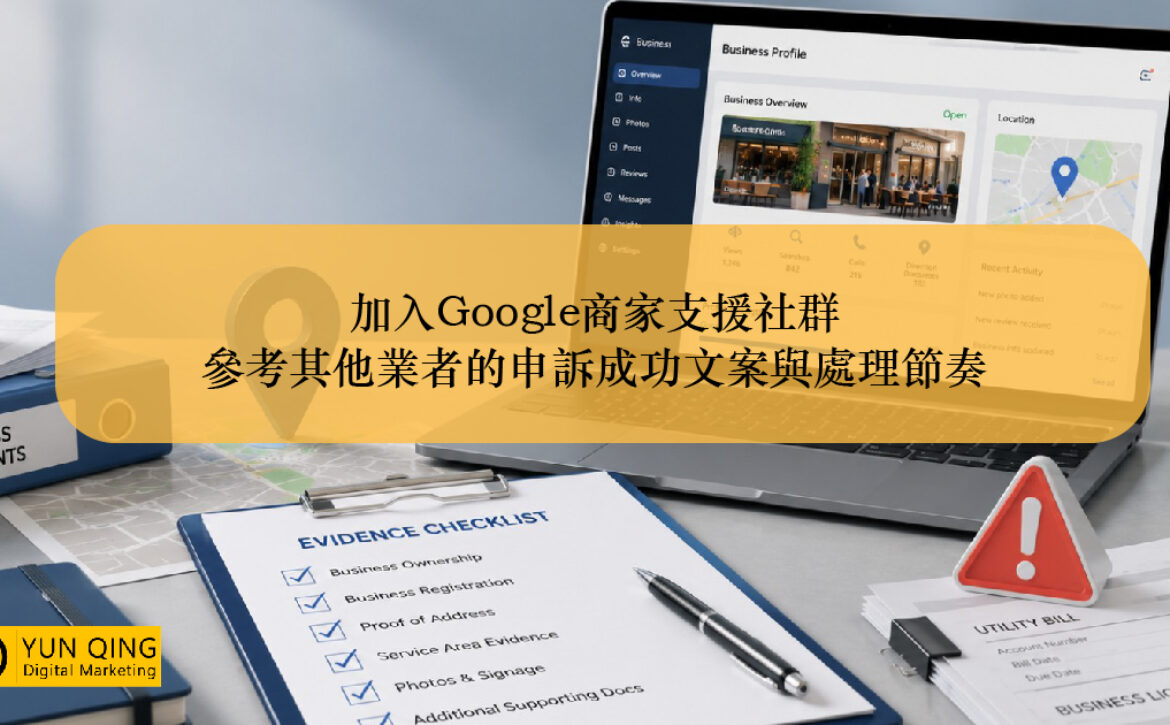
從事實體店家經營與數位行銷這十幾年來,我處理過的Google商家檔案(Google Business Profile,舊稱Google My Business)申訴案件少說也有上百件。從一開始單打獨鬥、在官方表單來回碰壁,到後來懂得利用「Google商家支援社群」的力量,參考其他業者成功申訴的文案與處理節奏,整個歷程讓我深刻體會到:與其自己埋頭苦寫申訴信,不如先坐下來看看別人是怎麼贏回商家檔案控制權的。
Google 商家檔案(Google Business Profile,簡稱GBP)上的評論系統,是Google地圖生態的一部分。Google的立場很明確:評論是「使用者生成內容」(User-Generated Content, UGC),目的是幫助其他消費者在做決定前,獲得真實、多元的參考資訊。評論的存廢,取決於「內容是否符合Google的政策」,而不是「商家想不想被評論」。